10/18/11

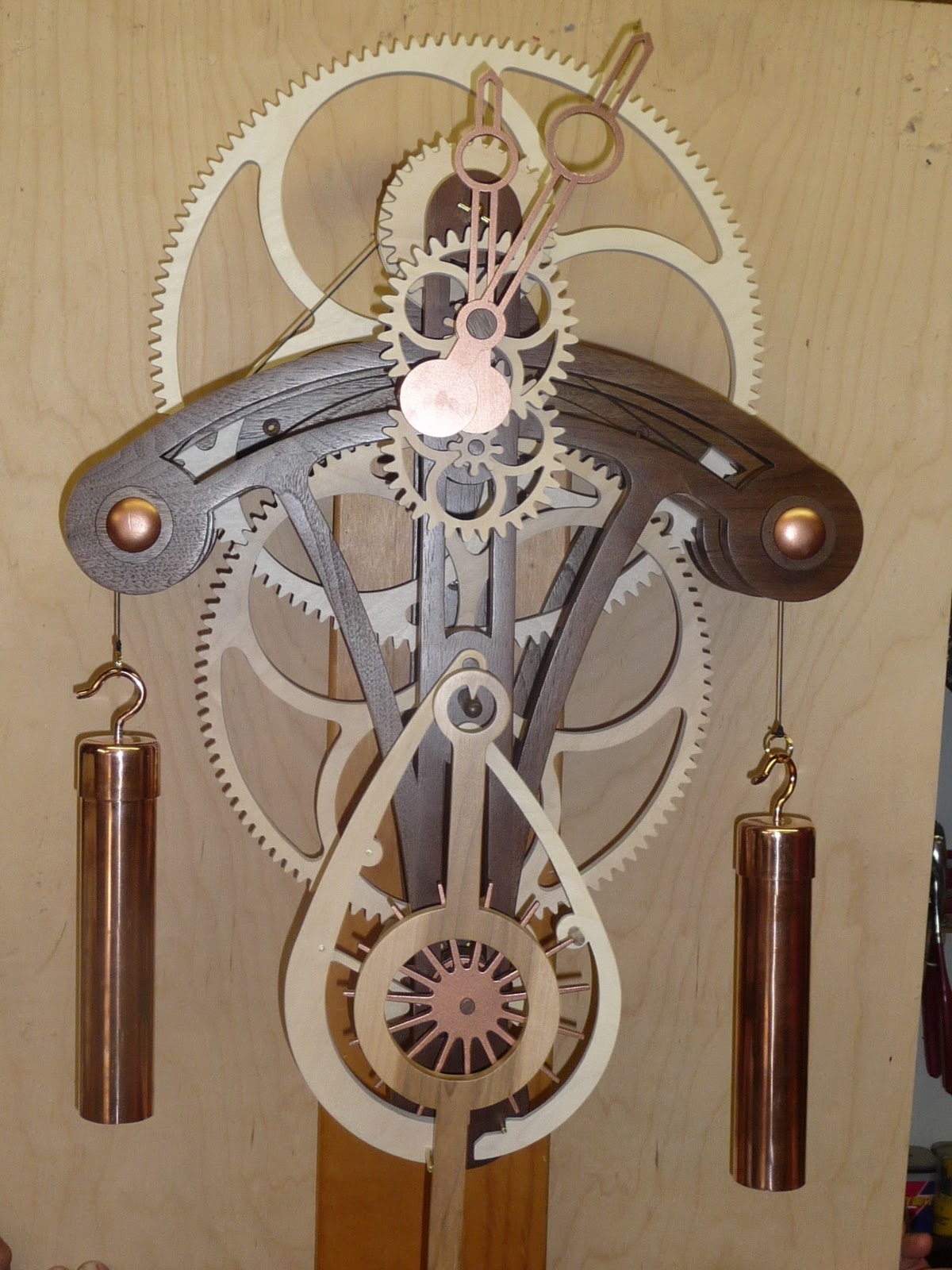
Ric Paulson and his Number Six

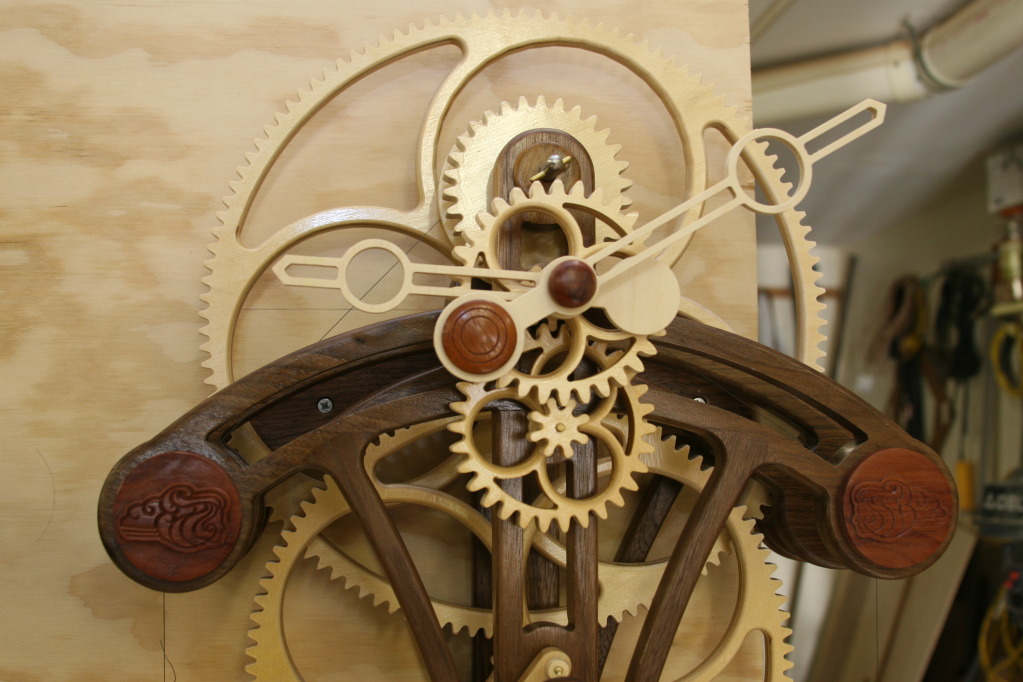
Ric Paulson and his Number Six


Ric emails:  "Hi Doctor Boyer,

As the picture attests,  the Number Six is finished and running. That bag that looks like an IV is my version of a test weight. I’m now in the process of dressing her in Red Oak. Nothing wrong with the Baltic Birch but this is going to someone who requested the oak.

This is actually my third clock, I bought a kit which turned out to be a big mistake. It turned out rather flimsy and although I could get it to run on occasion it spent most of the time at rest. The problem turned out to be simple but makes every build of mine an exercise in modification. I live just outside the city with the highest annual average humidity in the U.S (including Alaska and your home state). Bellingham, Washington has a average humidity of 79.4 %, if it was constant it wouldn’t be an issue but the big swings from day to day cause havoc with the wood. My biggest headache is boring the arbor holes and having a nice tight fit one day and an oversize hole the next. I ended up adding dowel set collars to everything.

Next I built your Genesis from the magazine and although it runs quite nicely for long periods it seems to make up its mind to stop at irregular moments. I suspect the humidity has something to do with it, I just haven’t found time to track down the cause. #6 ran right from the beginning and I didn’t even have to adjust the beat, she seems immune to the humidity.

I’ve enjoyed every minute of the process so far (yes even the frustrating ones) and I’m going to order another plan set just as soon as I finish this message. You are bringing a lot of joy to those of us who wrestle with wood so please keep it up!

Warmest regards,

Eric (Ric) Paulsen

PS: One last thing: I discovered what happened to that old Craftsman scroll saw you had. A company in China bought it and thought that the vibration was a “feature” so they added some more and made thousands of them. I of course bought one, I have since upgraded but I’m not sure when my arms will quit shaking. They must have had some of the “feature” left over because I bought a band saw from the same company and it is loaded with it too!"


Clayton agrees: "You have confirmed what I have also found about the Number Six. It is the best, least humidity sensitive clockworks that I have. It will run, flawlessly, up to about 85%. Then it gets real quiet around here.

Genesis is more sensitive for a couple (or many) reasons. That 60T escape wheel, and the uniframe. The frame would be best made from ply, because I know it's shifting around under all those wheels.

The Craftsman scrollsaw?  I still have dreams that my back teeth are vibrating. No other machine has had quite as significant an affect on my psyche as that one.

BTW, if you should have any interest, you now qualify for entry into the Masochist's Corner...
The secret path begins (this part censored...again! --Lisa). You are now in the inner sanctum of the Masochist's Corner, and may peruse any and all of the creatures that live there...Welcome.

Aloha. Clayton"

10/16/11

A Short Post from Clayton


This morning, via email, I received some of the highest praise I have ever gotten:

"Thanks for your many inspirations. You have truly made it possible for me to become an obsessive, reclusive nut case."

Solaris by Brent Martins

Solaris by Brent Martins

Brent writes:  "Aloha Clayton,

I hope everything is going well for you in Hawaii. I managed to complete my Solaris build this summer in time to give to my sister as a wedding gift. Everyone who sees it is amazed. It took me a couple of weeks to overcome clock withdrawal; I think I was addicted to the little thrill you get when you listen for the clock's beat and are reassured that all is well when you hear it working away. Moving on to new challenges, I am interested in attempting a Radiance build. To facilitate this, I have attached the obligatory picture of my Solaris for your review. Should you find my "demented lack of frustration" sufficient, I look forward to receive the much sought after Secret Link to bring me one step closer to fulfilling my masochistic goals.

Best Regards,

Brent"


Clayton answers:  "Well done, Brent! I love hearing stories like yours. I feel the same way about my clocks ticking away all over my house. My ear picks up that one, out of all the others ticking away, that I had forgotten to wind and had stopped.

Your beautiful Solaris more than qualifies you for membership into that elite cadre of masochistic woodworkers, and the secret path into the Masochist's Corner begins (note from Lisa--SORRY!  Secret path information removed!).

Congratulations, and welcome.

Aloha. Clayton"

10/13/11

Marble Strike by Leonel Leite


Marble Strike by Leonel Leite (click on any image to enlarge)

Leonel writes: "Aloha Clayton,

I send you some photos in large size of "my" Marble Strike, so you can see in more detail what it took me a few months of work! ...


 Give me your opinion about it.

I wish you continued happy holidays.

Aloha. Leonel"

Update 10-22-2011--Leonel has sent a YouTube video of his beautiful Marble Strike clock in action:


Clayton writes: "Leonel! That Marble Strike is absolutely beautiful! Wonderful work, Leonel. You have certainly done the MS plan very proud. Congratulations on creating such a wonderful mechanism.

Thanks for the beautiful pix.

Aloha. Clayton"

10/12/11

Putting Your New Clock into Beat: Serkan Yaliz's Simplicity

Simplicity by Serkan YALIZ

Serkan writes:   "Aloha Clayton,

Hello fron Ankara-Turkey. We had purchased the plans nearly a year ago.
"She" is ticking finally :)

And keeping the time with an error of +1 min per hour. I can tune her up if you have any suggestions.

Looking forward to purchasing new plans from you.   Have a great day.

Serkan YALIZ"

Clayton writes:  "Aloha Serkan, nice to hear back from you.  Thanks for the pix.  It is always nice to see a new clock being put into beat.  They are such wonderful mechanisms, and it looks like yours turned out beautifully.  Your wheels look so clean and crisp!  Nice craftsmanship.

You don't say if she is running fast or slow each hour, but right now it does not matter because during the first four to six weeks it is best just to let them run,and then after that time, after they have 'broken in', make changes.  Some clocks just naturally run fast or slow for a few weeks and then get into their natural beat.

I would guess from seeing your craftsmanship that your clock is running fast.  After the break in period if she is still running fast you can; add more bob weight, lengthen the pendulum shaft, and/or decrease the drive weight.  But a fast running clock is only a testiment to your craftsmanship because it tells me that there is very little internal friction.

If your clock is running still running slowly after six weeks it is a simple matter of shortening the pendulum shaft by 1/2" (12mm) at a time and retest.  Your bob should be in mid position on the threaded rod when you retest.  That way you'll have plenty of adjustment room, up or down, to get your clock into perfect beat. 

Perfect beat for a pendulum clock is about one minute error per day, but remember that will change as the weather changes.

Thanks for the beautiful pictures of your clock that is so happily ticking away over there in Turkey.

Enjoy.

Aloha.  Clayton"

10/6/11

Number Six by Keith Thomas

Number Six by Keith Thomas


Keith writes:  "Dr. Boyer,
I have just finished my #6. I started with all baltic birch but thought it was too "white" so remade the frame out of zebra wood, looks alot better I think.
I just got plans for your Wee Willie clock and noticed your email on the plans so thought I would drop you a line. It looks like it will take a while to make but will be enjoyable. I enclosed a few pics, one is a wood Harley I did a few years ago.
Harley by Keith Thomas (this plan not sold or designed by Clayton Boyer)

I will send pics of my Willie clock when completed. Thanks for the plans, it is an enjoyable hobby.


Keith Thomas"

Clayton responds:  "Keith, I really enjoy seeing the personal touches woodworkers put into their projects. Your Fleur-de-lis hands and beaded dial ring blend nicely with your zebra wood frame.
I was actually glad to see you went with the lighter in weight copper hands on your finished Number Six clock. The wooden ones may have been too heavy with all their "Fleur" out to one side. Imbalanced hands can be difficult for a clock to lift after they leave the six o'clock position. Going with the lighter copper hands was a brilliant move, and they look very nice with your wood choices, too.
I can see with all the woodwork you have on your walls why you didn't want the "white" look of the Baltic birch ply frame for your Number Six. The zebra wood fits nicely into your home. I won't be showing your Six pix to my Number Six though...she'll get jealous and be wanting a new frame.
The Wee Willie really is a fun, and pretty easy build. It is a small clock and accuracy in drilling and cutting is extremely important. I don't usually build more than one of any design, but we liked the WW so much that I built a second one and am presently designing a weight driven, wall hung version.
Very nice to hear you are enjoying this wonderful hobby, and your work really does these designs proud. Thanks for the great pix.
Amazing detail in your Harley sculpture. Congratulations.
Enjoy. Aloha. Clayton"

10/5/11

We Haven't Talked About Those Evil Bushings for a While

Email dialog between Clockbuilder Gene (black print) and Clayton (red print):

Clock builder Gene writes:
"I will admit, I have about come to the end of my rope.  At one point I have had my clocks (2) run for up to 48 hours, non-stop. At that point they were running fast, so I thought I would lengthen the shafts by two inches. So, I cut 2 inches off of the 36.25” and added 4” to the middle of the shaft using a lighter colored wood for contrast. When I tried to restart the clocks neither would run for more than an hour. I have tried every think I can think of to get them to run smoothly again. I’ve polished everything that I can get to hold still.  I have even tried to add brass tubing to the ends of the arbors to act as a bearing. If I turn the wheels by hand they seem smooth as silk. But when I add the escapement and weights and try to start them they will stall after a while. It seems like there is not enough force to turn the escape wheel to the next spook. I tried adding more weight to the Weights. With little or no change.  I tried adding heavier string and more of it to fill the take up spool. Nope…………. No good….. no help.
Question: Do you think that it may have been a mistake to put the brass tubing on the ends of the arbors?
Thank in advance for the help………………………. If you have any extra straw laying around may I borrow some…………….. because I have been grabbing at all the straw that is around here.
Wish I had a video camera.
Gene"

"Aloha Gene,

The answer to your question is:  OMG YES! Any sag of the frame whatsoever will bind the arbors with brass inserts. I think you may have found your problem.

In my very first clocks I put brass bushings - big mistake. Now I NEVER put in brass except possibly at the weight end (but don't even consider using them there either).
When I went to the NAWCC Museum and Library in Columbia PA I saw a 300 year old clock still in running condition that used only metal arbors on wood plates. After 300 years you might want to consider bushing, but I doubt it.

Clayton"

"Thanks Clayton. I thought that the brass bushing with oil would solve some of my problems. But after studying the workings for the last week, the bushing were the only thing I could think off that I might change. Guess I’ll go back, fill the holes and re-drill them. What do you thing would be best to use, water base or oil base filler?


The clocks look nice but if they won’t run for more than 10 minutes, I will never be happy with them. My oldest daughter, Stephanie, tried to make me feel better by saying she didn’t care if it runs or not she just thinks it will look nice to have on her wall. She knows I’m a stickler for detail. And before I will let them leave my shop, they will be right."


"To correct my beginner's error in my first clocks, I went back and pounded in wood dowels with wood glue, and re-drilled. Tricky, but it can be done, and I think you'll be a lot happier with their performance. Drill slowly, in and out, with a Brad point bit because this time you'll be drilling with the grain instead of across it...unless you make plugs! 

"You may be right about the plugs. They would be good and tight and not need much glue. I could make 3/8”plugs using a plug cutter from the same wood as the frame and I think the arbors would be happier in the cross grain. And plug from both sides, where needed. If this works I’ll let you. My wife will tell you that I threatened to burn down my shop with the clocks in it. But now maybe I can wait a week or two."

And later Gene writes:


"Many thanks for your help. You were right about the brass bushings. I plugged the holes with 3/8” walnut plugs and re-drilled then to 9/64” & 13/64”.


I think part of the problem was caused because when I cut these holes on my CNC I was having some feed rate problems with it and the holes were not perfect in size. This time I drilled them using a brad point bit that I had ordered from the internet. I only have to make 6 small shaft caps and I’ll be sending these to their new homes. The shop will seem like something is missing when they go. But off to a new project, Riding my Honda Gold Wing to Montana and Glacier National Park in June.


P.S. I think I have solved the problems with my CNC, the last time I used it ran perfectly.


Thanks again for the plans & the help.


I’ll be BACK


Gene"