1/29/12

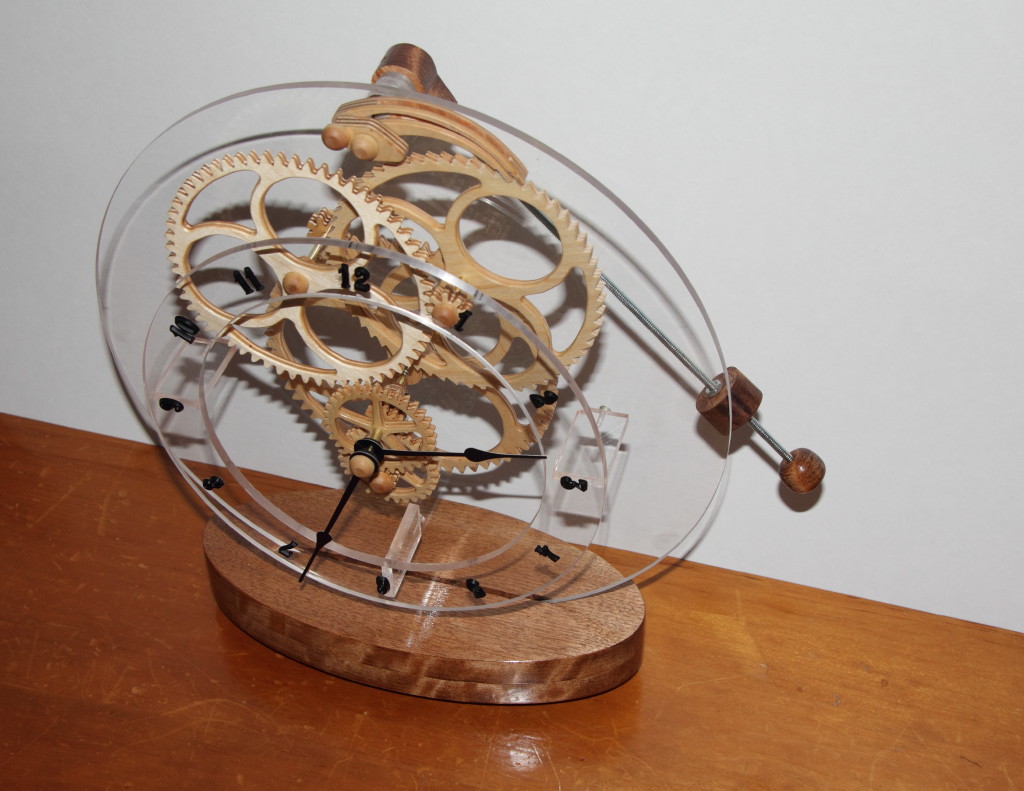
Space Time Continuum by John Fast


Space Time Continuum by John Fast
John Fast emails:  "Hi Clayton,
 
I completed your Kinetic Sculpture design recently and thought you might be interested in seeing the results in these 10 photos. I followed your advice and constructed all the cogs, etc. from Baltic Birch ply. Except for the cogs, I veneered all the other parts to cover the ply layers. The main supports are of Purple Heart wood. I changed the design on the balance wheel a bit. I could not find any suitable marbles, so I made my own as well as the weights out of a piece of soapstone that I couldn't find any use for over the past 15 years. I also had to add the extra weight shown to keep it running. We don't have much humidity here in Winnipeg, Canada, so that isn't an issue for me. I'm really pleased with the result and while it may not be as perfect as your work, it looks great in our living room. Thanks for a great design.
 
Cheers,  John Fast"
 
Note:  Click on any of these pictures to enlarge: 


Clayton answers:  "Wow, John, you do magnificent work!

I hate to disagree with you, but your Space Time Continnum is way more perfect than mine! Yours is truly the art of a craftsman, and those soap stone counterbalances are beautiful art pieces in themselves. I'm glad you found a good home for them. I guess that's why they have been so patient for the last 15 years. They were just waiting for their place of signifigance in your sculpture.

Thanks for doing such a spectacular job on your Space Time Continuum. You have truly done that design proud.

Congratulations.  Aloha. Clayton"

1/27/12

Must Read: John Hilgenberg's Helpful Tips for Building a Wooden Clock

John Hilgenberg's Marble Strike Clock
For many years, John Hilgenberg has built many of my designs, and created expert designs of his own. Here are some of the ways he approaches building a wooden clockworks. Some of his methodologies are identical to mine, and some may vary from my recommendations – but he has been kind enough to put his methods down on paper, and I present them here for your perusal and hopefully some of this information, from his vast store of clock making knowledge, will work for you, too...
 
Here is the link to Johns' advice on my website:  FAQ's: John's Tips

1/13/12

Simplicity by Barry Coleman


Simplicity by Barry Coleman
Barry emails:  "Hi Clayton.    Barry Coleman here, thank you for plans sent, here are pictures of the finished clock.   It runs on about 7 pounds of brass, losing about 1 minute an hour at the moment, will trim.

This is my first clock, can hear it ticking now, very satisfying.

Regards, Barry"

Clayton answers:  "Congratulations Barry, you did a nice job on your Simplicity. I love to hear these 'first time' stories because I still enjoy hearing about a new clock being put into beat.

Give your Simplicity some time to 'break in'. Some clocks run fast or slow in the beginning. Give it two or three weeks before any major tweaking.

I agree - hearing her ticking is quite satisfying.

Great job on your Simplicity.

Aloha. Clayton"

12/17/11

Toucan by Paul LaRue

Toucan by Paul LaRue
Paul emails:  "Allo Clayton

Here are pictures of my version of Toucan !

Great design.

ps. By using miniature ball bearings on the pendulum axis

it now operates on 6 VDC rather than 9.

I will now build Wee Willie for my first Grand Child (scheduled birth

- New year's day !)

Joyeux Noël

Pal "

Clayton:  "Glorious, Paul! I always expect magnificence out of you, and you never fail. Your Toucan is an absolute beauty. With the use of an acrylic frame, the mechanism looks as though it is floating. That's a totally cool idea!

Thanks also for the heads-up on the bearings for the pendulum. As you know from reading my blog, I detest brass bushings because they increase internal friction. Unfortunately, I had to use one there at the pendulum to keep it tracking correctly. Your bearing idea is truly an improvement if you can decrease your voltage by 33%. Congrats.

Yet another Great PAL creation. Congratulations.

Aloha. Clayton"
12/4/11

Solaris by Danny Jacques

Solaris by Danny Jacques

Swoopy Variation by Peter Franklin

An All-Metal Wheeled Swoopy by Peter Franklin
Peter writes, "Hi Clayton.
I have the clock finished and looks great it will run perfectly for about 30 teeth on the escapement gear,then the pendulum stops rocking.  I can't find any problems but there is obviously some small thing.

What actually keeps the pendulum swinging?

I changed the weight tube to a bigger one.

Then I changed the second wheel bearings over to bronze bushes instead of the bearings.
I immediately was able the take 4 lbs of lead off.


The load on the escapement wheel feels great now.

Regards,
Peter Franklin"

Clayton answers:  "Beautiful, Peter!!! Your metal wheel Swoopy is certainly an outstanding beauty!

Check out my FAQ's on my website, especially, "Why Doesn't my Clock Run?" and "Depthing." Also, these grasshopper escapements tend to slip where the verge meets its arbor. Many woodworkers have added a second Allen Screw for a more secure, tight fit.

What actually keeps the pendulum swinging?  I answer this question in detail in my blog.

I always find it interesting how we automatically think that bearings are better than bushings, when in reality, many times they ADD to the internal friction.

Thanks for the beautiful pictures of your metal wheeled Swoopy. You did an absolutely excellent job recreating her in metal. She's a beauty!

Aloha. Clayton"

11/26/11

Tony Cameron's Model T

Model T by Tony Cameron
Tony:  "Hello Clayton,

Having completed my version of your Model T, I am inspired by you and your designs.  This is my second wooden gear clock,  my first one from Fine Woodworking about 20 years ago (which my first wife has).

I would think I am not the first to lose a clock to a wife.


The Model T was a delight to build.  The frame is from Tasmanian Myrtle, and the gears are from ply I made by laminating 1.6mm bending ply.  The bending ply has 3 laminations of Hoop Pine, so I laminated 6 pieces of ply and then veneered both sides with Queensland Walnut ( 20 laminations in 12mm ply should be stable).  The weight is lead poured in a metal pipe, which is in a sleeve of Queensland Walnut.

I finished the clock with 3 fine coats of Kunos Oil.


The Model T has been working constantly now for a month, and I am pleased by the kinetic sculpture’s accuracy.  It is lovely to come home and hear the ticking.

If you consider my woodworking ability satisfactory,  I would appreciate it if you would send me the link to ordering plans for your Radiance.  I am amazed at a how a one wheel, no gear clock can work. So am I stupid,  or perhaps I love the challenge it presents?

Clayton, the builders of your designs have the easy part,  you and your creations are amazing.

Many thanks,  Tony Cameron"


Clayton:  "Wow, Tony, those wheels look good enough to eat!  They look like chocolate.  Yes, 20 lams in 12mm is amazing.  My Baltic birch ply has only about half that many.

I joke about how inaccurate these clocks are - only because I don't want anyone getting stuck on the accruacy part - but they truly can be amazingly accurate, easily to one minute a day.

It's also nice to hear that you like her unusual song.  I love that 'ticking' sound that she makes, too.  So unusual, and very pleasant.

Your submission more than qualifies for your entry into the Masochist's Club.  Welcome, Tony, to that cadre of elite wooden clock builders that make up the Masochist's Club.  It is a pleasure to admit such a craftsman as a new member into this exclusive club.

Your Model T is a beauty.

Enjoy.

Aloha.  Clayton"