3/30/13

Verge and Foliot Escapement Adjustment on Horologium

Horologium by Joe Coser
Joe Coser writes:
 
Good morning Clayton,
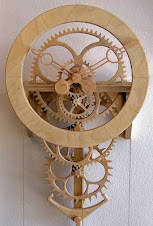
Attached is a picture of the Horologium I just finished. Thank you for the excellent plans and directions.  I am working on the time it runs fast. I have reduced the weight to 5#--I think I will try reducing it more before making the alternate wheel.
Thanks.
 
Very nice work, Joe. Your Horologium is a beauty. Each part of your clock is so crisp, and clean, and well made. Your excellent craftsmanship shows throughout your build.
 
You are correct about decreasing the drive weight if your Horologium is running too fast. Many of my clocks have escapements that are not very sensitive to how much drive weight is applied and a little excess drive weight is not a problem. That is not the case with the verge and foliot escapement of the Horologium. V&F escapements are very sensitive to changes in drive weight, and as an aside that is why, instead of using a standard clock mainspring, I went with a constant force spring in the Wee Willie. A verge and foliot escapement requires that the drive force applied to it be constant.
 
As you probably read in the instructions for the Horologium, there are three ways to change the speed at which this type of escapement runs; 1) vary the drive weight, 2) open or close the "wings" of the foliot, or 3) change the number of pins on the escape wheel. Actually, there is also a fourth method and that is to add more weight further out on the pendulum's shaft. In other words make a wider or heavier foliot. That could be by adding additional weight in the wings themselves or a separate foliot addition down by the sphere you have put on the bottom of your pendulum's shaft (actually, adding weight further out anywhere along the shaft would work.). You can see how John Hilgenberg did just that by checking out the picture of his Horologium in my Flickr' link.
 
Thanks for sending the picture so we could all see the great work you put into building your Horologium.
 
Enjoy.
 
Aloha. Clayton

2/28/13

Simplicity by Karl Noren


Simplicity by Karl Noren

 Dear Clayton, 

I'm a newly retired electronic engineer; my main hobbies are Fishing and Woodwork. I purchased your plans for the Simplicity Clock to fulfil an ambition I had to make a wooden clock movement. Once I retired and had the time available for such pursuits.

I found your plans very well worked out and fairly easy to follow, (after converting your inches to metric) the clock is now finished and hanging on the wall and keeping good time.

I made the big cog wheels using plywood but the rest is made from a local hardwood, Jarrah, (see link) it is my favourite wood and I have made several pieces of furniture over the years. If I get around to making another clock it will be all Jarrah but I can't get Jarrah plywood so I probably have to do my own laminations.


I got the clock to run OK on about 4 lb, I settled for a weight of 5 lb 3 oz, (to give it some reserve power) lead enclosed in a cylinder made from jarrah, I had to reduce the length of the pendulum rod by 2.5" to get it whitin range.

http://www.hardwood.timber.net.au/species/jarrah.htm

Karl Noren
Perth
Western Australia


Aloha Karl, you have created an extremely beautiful Simplicity. I can understand why the Jarrah is one of your favorite woods ~ it's color and depth and overall appearance is spectacular!

I think you have created the first Simplicity Dial Ring that is rotated an additional 15 degrees. It looks wonderful with the inlayed dots and spaced separations. Brilliant!

Your final drive weight is perfect, too. Since the Simplicity is a beginner's clock, my drive weight recommendation is way high. I put it up there because I want every builder, no matter their level of craftsmanship, to be able to hear their clock tick. The drive weight you have attained is a testament to your craftsmanship...as if one couldn't see that throughout the rest of your clock. You've done a truly spectacular job on your first clock(!)

For solid wood wheels or on how to lay up your own ply wheels, check out the "Ron Walters" link in the "Favorite Links" section of my site. He has done some superlative work with solid wood and homemade ply wheels.

Thanks for the beautiful pix and for doing the Simplicity plan so proud.

2/13/13

Celestial Mechanical Calendar and Orrery by Dave Beran


Celestial Mechanical Calendar and Orrery by Dave Beran
1/22/13
 
Clayton,

Here are a few pictures of CMCO proudly residing in our entry way. It has been complete but required final disassembly for final sanding, varnishing and decorating. You will notice that the weight cord has been relocated. After careful hanging on the wall the weight would land on a chair we keep there. So I made a pulley, stolen from Simplicity plans, and a new mount to relocate the weight. Bev loves CMCO and we advance it together each morning.

I finished all wood parts, except gear teeth, with wipe on varnish and the orrery colors are Transtint dyes. These dyes are mixed with alcohol and color the birch very evenly. The paper parts are also dyed with a 'brown' I concocted from the dyes. I think it gave them a nice 'old' look.

I've had CMCO running in the shop since last March and would probably still be there if I known it would take two weeks to properly dress her up!

Oh, by the way. The thermometer next to CMCO read -23 this morning!!!

Dave Beran
Duluth, MN


Dave, I just can't tell you how much joy I get from seeing great craftsmanship ~ and especially when it is applied to one of my two All Time Favorite designs, the CMCO.

When I read that you and Bev advance it together in the morning, I was just totally filled with joy. What a great email!!! That was just so wonderful to read.

There is just nothing like seeing all that fluttering and gyrating going on with the simple unleashing of two levers. And to be able to look on your wall at a bunch of gears and see what is happening in the Cosmos is almost unbelievable (at least it still is to me).

Your CMCO really came out superb. Thank you for doing the CMCO plan so proud! And I really love the displaced drive weight. I think that looks wayyy better than my original design (I'm so glad that chair was there. Ha). Using one of the Simplicity wheels was brilliant.

Congratulations on a spectacular build, and thank you so much for the pix and totally wonderful email. You've made my day!

Enjoy!

Aloha. Clayton

12/18/12

Attention Christmas Gift-Shoppers! Yes, it IS getting close to Christmas for regular postal delivery. But the good news is that you can order the following items in dxf format and have them delivered via email attachment within 24 hours. It's not too late to order the following plans available in dxf:

1. Clayton's pdf book, "A Practical Guide to Wooden Wheeled Clock Design"

2, Genesis, the World's Easiest Clock:

3. Perpetual Calendar:

4. Weird Gears

5. Cogitation Kinetic Sculpture

And in Masochist's Corner (previous wooden clock making experience required, see requirements):

6. Epicyclic

7. Leeds 7-Day

Have a Merry Merry Sawdusty Christmas!  Thank you for your patronage over the years, and thanks for taking the time to stop by and read our blog.  Mele Kalikimaka, Clayton and Lisa Boyer

12/15/12

And a Story of Woe and Joy after Applying Finish...

Simplicity by Dave Beran

Clayton,

After a month of my Simplicity faithfully tick/tocking in my work shop I decided to dress her up a bit and move her into the house. So I disassembled her and did some staining and finishing of all the non-moving parts. Upon re-assembly, nothing. Raised the weight to a full 7 pounds, nothing. Now how often has friction been mentioned in your comments and on the blog? So apart she came. I'd discovered a tiny amount of finish on the brass arbors. So I polished up the arbors, spun pipe cleaners in all the brass tubes and turned drill bits, by hand, in all other holes. Upon reassembly she came alive. My Simplicity is now running on 3lbs with a 4oz counter weight. And after a few days of adjustment I have her dialed in to about a minute or two per day. By the way, the hands, dial, and weight shells are walnut. It was was recycled from pallet planks found while helping a friend boil maple syrup last spring.

Thanks for the new hobby, now on to the Flying Pendulum gizmo.
 
Dave Beran
Duluth, MN
 
Aloha Dave, unfortunately yours is too common a tale. It really is amazing how little finish it takes to get these kinetic sculptures to become a "still life". There are two things that will bring these wonders to a dead stop faster than anything and those are 1) finish, and 2) bushings. Fortunately, both are avoidable!...well, bad craftsmanship has to be in there somewhere, too, but that sometimes can be overcome by reading and following the recommendations in my FAQ's.
 
It's good to hear you got your finish problem solved and she's up and running again. And, congratulations, by the way, on your amazing craftsmanship. Not only is she a beauty, but you got her running on less than three pounds.
 
That's actually the weight she's supposed to be able to run with, but since Simplicity is a beginner's clock, I bumped up the initial weight recommendation because I wanted everyone, no matter how bad their craftsmanship, to be able to hear their clock tick. Your craftsmanship, on the other hand, is superlative.
 
Congratulations, and I know you are gonna love that Flying Pendulum design, too. I keep mine just above my Mystery Box. Both are guaranteed to bring a smile to the face of whom ever views them.
 
Enjoy.
 
Aloha. Clayton
 

11/15/12

Keith Randall's Happy Wall

video
 
 
Solaris, Simplicity and Number Six by Keith Randall, all ticking away together.  This is wonderful!  Thanks for the video from Australia's Sunshine Coast, Keith.
 

11/11/12

Simplicity by Peter Rosemeier


A nice email and Simplicity pictures from Peter Rosemeier in Germany:
 
Aloha Clayton,

now, "The Simplicity" is ready and I want to give you a short report and some pictures.

At the beginning: I have your plans from the Simplicity, but I have no machines to built the clock. -No bandsaw, no drillsaw, no bench Drilling Machine, no plate sanders, no workbench etc.
... and I have no experience with that machines ...


At the end of "The Simplicity-building" I see all this machines in my new workrooms and now I have three workbenches, a circular saw and even a small lathe. -Great!!-
And the experience with the operations of the machines come with the construction of the Simplicity and in addition, I learned how to Build a Wooden Clock.


So I can only say: Thank you very much for the great Simplicity-clock-plans and the
experience that I have made by building the clock. It was a big adventure
and I have had a lot of fun here.

Now, from time to time I visit your homepage and I see
"The Leeds-7Day-3Wheel" and on Youtube the Variation of it "The Northstar"
... and my creation-fever is growing up... ... and up...
...probably because I studied engineering... -The internal gears, the pulley on the hour-arbor,
one wind for a week - Great !! -

"Peter", I say to myself, "that´s the right Cristmas-Fun".

Now, I order "The Leeds-Plan-Kit" .  Please, give me the Dimensions of the Clock, because I look for a nice Place on the Wall in my House .

Aloha,  Peter Rosemeier


Well done, Peter! With no prior woodworking experience you have created one amazing clock! You are a wonderful craftsman.
I enjoyed seeing how you designed the bell for the Hourly Strike Mechanism. Wonderfully done!
Excellent work. I can hardly believe that you began as a complete novice and ended up with such a beautiful wooden clockworks.
Thank you for the pictures. You have created a mechanism you can truly be quite proud of. Congratulations on a wonderful build.
Aloha. Clayton