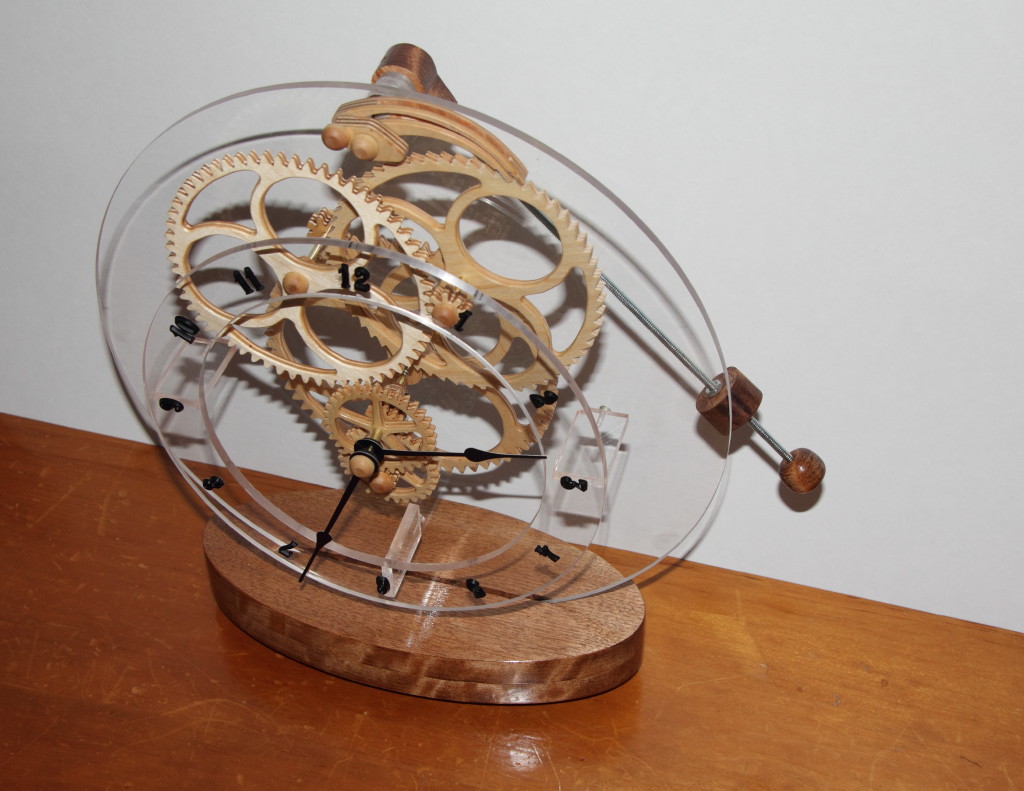
ps. By using miniature ball bearings on the pendulum axis
it now operates on 6 VDC rather than 9.
I will now build Wee Willie for my first Grand Child (scheduled birth
- New year's day !)
Joyeux Noël
Pal "
Clayton: "Glorious, Paul! I always expect magnificence out of you, and you never fail. Your Toucan is an absolute beauty. With the use of an acrylic frame, the mechanism looks as though it is floating. That's a totally cool idea!
Thanks also for the heads-up on the bearings for the pendulum. As you know from reading my blog, I detest brass bushings because they increase internal friction. Unfortunately, I had to use one there at the pendulum to keep it tracking correctly. Your bearing idea is truly an improvement if you can decrease your voltage by 33%. Congrats.
Peter writes, "Hi Clayton.
I have the clock finished and looks great it will run perfectly for about 30 teeth on the escapement gear,then the pendulum stops rocking. I can't find any problems but there is obviously some small thing.
What actually keeps the pendulum swinging?
I changed the weight tube to a bigger one.
Then I changed the second wheel bearings over to bronze bushes instead of the bearings.
I immediately was able the take 4 lbs of lead off.
The load on the escapement wheel feels great now.
Regards,
Peter Franklin"
Clayton answers: "Beautiful, Peter!!! Your metal wheel Swoopy is certainly an outstanding beauty!
Check out my FAQ's on my website, especially, "Why Doesn't my Clock Run?" and "Depthing." Also, these grasshopper escapements tend to slip where the verge meets its arbor. Many woodworkers have added a second Allen Screw for a more secure, tight fit.
What actually keeps the pendulum swinging? I answer this question in detail in my blog.
I always find it interesting how we automatically think that bearings are better than bushings, when in reality, many times they ADD to the internal friction.
Thanks for the beautiful pictures of your metal wheeled Swoopy. You did an absolutely excellent job recreating her in metal. She's a beauty!
Having completed my version of your Model T, I am inspired by you and your designs. This is my second wooden gear clock, my first one from Fine Woodworking about 20 years ago (which my first wife has).
I would think I am not the first to lose a clock to a wife.
The Model T was a delight to build. The frame is from Tasmanian Myrtle, and the gears are from ply I made by laminating 1.6mm bending ply. The bending ply has 3 laminations of Hoop Pine, so I laminated 6 pieces of ply and then veneered both sides with Queensland Walnut ( 20 laminations in 12mm ply should be stable). The weight is lead poured in a metal pipe, which is in a sleeve of Queensland Walnut.
I finished the clock with 3 fine coats of Kunos Oil.
The Model T has been working constantly now for a month, and I am pleased by the kinetic sculpture’s accuracy. It is lovely to come home and hear the ticking.
If you consider my woodworking ability satisfactory, I would appreciate it if you would send me the link to ordering plans for your Radiance. I am amazed at a how a one wheel, no gear clock can work. So am I stupid, or perhaps I love the challenge it presents?
Clayton, the builders of your designs have the easy part, you and your creations are amazing.
Many thanks, Tony Cameron"
Clayton: "Wow, Tony, those wheels look good enough to eat! They look like chocolate. Yes, 20 lams in 12mm is amazing. My Baltic birch ply has only about half that many.
I joke about how inaccurate these clocks are - only because I don't want anyone getting stuck on the accruacy part - but they truly can be amazingly accurate, easily to one minute a day.
It's also nice to hear that you like her unusual song. I love that 'ticking' sound that she makes, too. So unusual, and very pleasant.
Your submission more than qualifies for your entry into the Masochist's Club. Welcome, Tony, to that cadre of elite wooden clock builders that make up the Masochist's Club. It is a pleasure to admit such a craftsman as a new member into this exclusive club.
Built a Simplicity clock per your plans. Clock runs well, but is several seconds fast/minute. I have tried adding weight to the bottom of the pendulum, but it does not make a significant difference. I was wondering if minimally reducing the diameter of the escape wheel would slow the clock down and wanted your advice in case it would be a move in the wrong direction. Attached are several pics of the clock in case you're interested. It was a very enjoyable project.
Thanks much for your help,
Steve"
Clayton emails: "Beautiful job, Steve. I especially like your turned weights. Very classy! You did a beautiful job throughout...and that may be part of your problem!
First of all, some mechanisms run fast of slow for the first few weeks. So I always recommend not doing anything for four to six weeks except enjoy the clock's beautiful song and not worry about the accuracy.
After that break in period, if it is still running too fast, you have some choices. The first would be to decrease your drive weight. I actually have the suggested drive weight WAAAYYY too high. The clock should run on about three pounds, but I suggest more because it is a beginners clock and I want everyone - no matter how bad their craftsmanship - to hear their clock run. It's also why I state that the drive weight for each clock will vary.
And this is where your great craftsmanship comes in - maybe because your techniques and accuracy and precision were so good, there's not enough internal friction to be overcome by the excess amount of drive weight - thus making your Simplicity run fast.
If that is not the problem then you'll need to increase the length of your pendulum shaft.
The third treatment you say you have already tried, and that's to add weight to the bob, thus making the apparent center of gravity for the pendulum a bit further away. And also absorbing some of that excess drive weight.
So start with; #1 waiting a while, then #2 reduced the drive weight.
You'll get her purring along just fine and she'll eventually be within a few minutes a day in accuracy.
Clayton emails a request to Rabbit: "Since your Marble Strike was featured on my blog on Halloween there has been a flurry of (well deserved) excitement over your beautiful machine. A couple of guys have asked if a video would soon be following.
Just thought I'd throw that out to you - personally, I'd love to see it in action, but no pressure either way.
Anyway, your Marble Strike is a totally striking machine (pun intended). Your work is always well beyond the capabilities of mere humans.
Congratulations on a magnificent creation."
Rabbit kindly responds: "thanks again for the undeserved praise. i feel famous, having made your blog!
unfortunately, my video skills are even worse than my photography... i should stick to woodwork. but, against my better judgement, i uploaded a pitiful movie, anyway: http://www.youtube.com/watch?v=HlJdfKYg6As&feature=youtu.be (Note from Lisa: this link takes you to the video shown above in the video player window) it shows one cycle of the remontoire, and an hour strike (preceded by the 'fourth quarter' bell). the sound, the lighting, the focus - all poor!
i'll try again at some point.
best regards,
rabbit"
In addition, Rabbit explains how his extraordinary version of the Marble Strike works. He first asks the rhetorical question...
"Howzitwork?
Well... it's rather complicated, but buy the same token, it is very simple...
Everything (the time train and two strike mechanisms) is powered by the 1" steel balls in the drive wheel. the weight of the balls in one side of the wheel provides all of the drive torque. It "rewinds" itself automatically.
The balls are pushed out at the bottom of their path. The mass of the ball on the off-ramp actuates a switch which starts the remontoire motor - a synchronous electric motor, mounted inside the base. The lower remontoire wheel picks the ball up, hands it off to the upper wheel, which deposits it in the on-ramp, to continue/repeat its journey. A cam on the remontoire drive wheel turns the motor off. (...two switches in series; one starts it, the other stops it.)
I must thank Steve Kretschmer for this inspiration.
The main drive wheel actually drives four separate gear trains - hours, minutes/hour strike, seconds, and escape. [this is a horribly inefficient way to drive a clock, but one of the design themes was, "make it as complicated as possible", and with the 'falling ball' remontoire, I could provide all the power it needs.] the drive wheel itself turns once every 15 minutes, so it actuates the quarter strike mechanism.
The minute train has its gear integral with the marble lift wheel, and is otherwise my own interpretation of Clayton Boyer's wonderful Marble Strike mechanism. The hour strike is Clayton's brilliance. His descriptions, and many other people's videos, have explained it better than I can.
The hour train is a "pointless" geartrain, consisting of several gears merely to translate the correct rotation to the place where I wanted the hour dial. The "hour hand" sits still, and the dial moves [the dial arrangement, and in fact a lot of the visual aspects, were inspired by Alain Saintangne's beautiful rendition of the Marble Strike.].
The escape train utilizes an appropriate ratio for the 1/2-seconds "shorty" pendulum - dictated by the "table clock" format.
It had to have a seconds hand, so a separate drive - a take-off from the escape train - does the trick.
The quarter strike is my own creation. It is a "passing strike" mechanism with two whistles and a bell - the proverbial "bells and whistles". A 4-tooth Geneva Wheel attached to the main drive wheel switches a 3-segment (6-lobe) cam every 15 minutes. the cam assembly either "makes" or "breaks" the fulcrum(s) to pivot arms which lift the (2) whistle bellows and/or the bell hammer. It toots the higher pitch whistle at the quarter hour, rings the bell at the half hour, toots the low whistle at :45, and does all three on the hour (followed by the Marble Strike hour count on the 'finely-tuned' wine glass gong).
'Simple as a mud fence, complicated as a watch'. I just love it."
Thank you Rabbit, for the video, the explanation, and for sharing your beautiful creation with all of us.